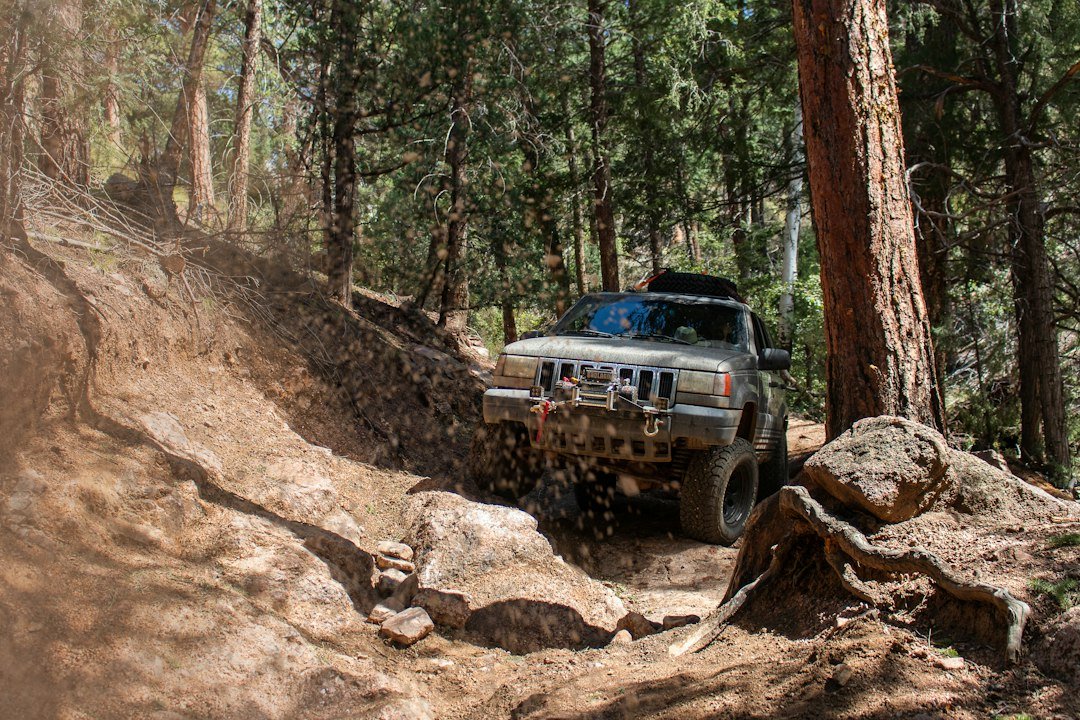
One rear tire spins in a muddy rut while the tire on the other side barely moves: what is a differential lock used for in that moment? A differential lock is used to make both wheels on an axle turn together, so the wheel with traction can help push the vehicle forward instead of letting all available drive go to the wheel that is slipping. That is the basic answer. In off road driving, a lock can get a truck, SUV, or 4×4 through loose ground or over an obstacle that would stop it with an ordinary open differential.
The name can make it sound complicated. It is not. A standard differential lets the left and right wheels rotate at different speeds, which is necessary whenever the vehicle turns because the outside tire travels farther than the inside tire. On loose terrain, though, that useful design has a drawback: if one wheel loses resistance, an open differential can send most of the usable torque toward that spinning wheel. The vehicle may stop. Locking the differential removes that left-to-right speed difference until you disengage it.
What is a differential lock used for on trails?
A differential lock is mainly used when traction is uneven across the axle. Picture a rear-wheel-drive pickup climbing a rutted hill, with one rear tire hanging light in a hole and the other pressed into dirt. With an open rear differential, the lightly loaded tire can spin while the loaded tire gets too little torque to drive the truck onward. Engage the rear locker. Both axle shafts are then mechanically linked, so each rear wheel receives turning force even if one has very little grip.
This does not create traction out of thin air. Tires still matter. So do ground clearance, tire pressure, throttle control, vehicle weight, and the surface under the contact patch. A locker simply makes better use of the traction that remains at one wheel. It is most useful at low speed, where the driver needs controlled forward motion rather than wheelspin and momentum.
Common situations include a cross-axle rut, loose rocks, deep snow, sand with uneven resistance, or a steep climb where one wheel unloads. Water crossings can create the same problem if a wheel drops into a soft hole. Use care. The goal is usually to crawl through the bad section with steady throttle, not to lock the axle and accelerate hard until something breaks.
How an open differential loses drive
Think of an open differential as a device that allows each wheel to choose its own speed. That is exactly what you want on pavement during a corner. The issue appears when one tire can spin easily, because the amount of torque the differential can deliver to the gripping tire is limited by the wheel with the least resistance. If the left tire is on glare ice and the right tire is on dry gravel, the ice-side wheel spins first. Progress can be poor.
A locked differential changes that relationship by forcing both axle shafts to rotate together. Wheel speed is shared. If the right wheel has usable bite, it can keep pushing even when the left wheel has almost none. On a technical trail, that can mean the difference between a calm crawl and repeated attempts with flying dirt. It also reduces the temptation to use excessive throttle. Less wheelspin is generally easier on the trail and the drivetrain.
There is a trade-off. Since the wheels cannot rotate at different speeds while locked, the tires scrub across the ground during turns. On loose dirt, that scrub is often harmless because the surface gives way. On dry pavement, it can load the axle shafts, differential gears, driveshaft joints, and tires. Unlock it. A differential lock is a traction tool, not a mode to leave on for normal commuting.
Rear, front, and center differential locks
Not every lock works on the same part of the drivetrain. A rear differential lock connects the two rear wheels together. This is the most common selectable locker arrangement on serious off-road vehicles, and it is often the first lock a driver uses because the rear axle carries a large share of the vehicle’s driving load during climbs. For many trails, a rear locker is enough. It can also be less disruptive to steering than a front locker.
A front differential lock connects the front wheels. It can provide major climbing and crawling ability when the rear axle alone cannot carry the vehicle, especially when a front wheel lifts or lands on a slick surface. Steering gets heavier. With the front locked, the vehicle often wants to continue straight ahead because the front tires cannot turn at different speeds. Many drivers use a front locker only after the rear is locked, then disengage it as soon as the obstacle is clear.
A center differential lock is different. It locks the front and rear driveline together rather than the left and right wheels on one axle. Full-time four-wheel-drive vehicles with a center differential need this type of lock, or an equivalent low-traction mode, to prevent power from flowing mainly through the axle that has less grip. It is useful on loose surfaces. It should not normally be engaged on dry, high-grip roads because the front and rear axles travel different distances in turns.
Some vehicles have all three. Others have only a rear locker, a center lock, or no mechanical lock at all. Check the owner’s manual before assuming a dashboard button controls a particular axle. Labels differ by manufacturer, and some systems will only engage in four-wheel drive low range or below a certain speed. The manual has the final word.
Selectable lockers, automatic lockers, and limited-slip differentials
A selectable locker is controlled by the driver, usually with a switch, button, lever, or drive-mode setting. It acts like an open differential when switched off, then locks when the driver asks for it and the system’s conditions are met. This gives the driver control. It is often the easiest setup to live with because it stays civil during ordinary road driving.
An automatic locker locks and unlocks based on internal mechanical forces. It can work very well off road, but it may change how the vehicle feels on pavement, especially in tight turns or when lifting off the throttle. There can be noise or a noticeable push through corners. That behavior depends on the locker design and the vehicle. An automatic locker deserves some practice in an empty, safe area before a long road trip or difficult trail.
A limited-slip differential is not the same as a full lock. It limits the speed difference between wheels and can send extra torque to the wheel with grip, but it generally still allows some differentiation. That makes it smoother for street use. It may not pull through a situation where one wheel is completely unloaded, although some brake-based traction systems can help by applying the brake to the spinning wheel.
Modern traction control can be surprisingly effective. It uses wheel-speed sensors and brake pressure to slow a spinning wheel, which encourages torque to reach the opposite side through an open differential. It takes a moment. A true mechanical locker usually reacts more directly in a slow, severe traction situation, but traction control is less likely to cause tire scrub when turning and needs no special action from the driver beyond selecting the right drive mode.
When to engage a differential lock
Engage a locker before the obstacle if possible, while the vehicle is stopped or rolling very slowly and the wheels are not spinning. That reduces shock loads inside the drivetrain. Read the terrain ahead. If you can see a cross-axle dip, a loose climb, or a section where one tire will likely unload, select the appropriate lock before entering it rather than waiting until the vehicle is deeply stuck.
- Stop and assess the line. Look for solid ground and avoid a route that will put a tire against a sharp rock or deep hole.
- Select low range if your vehicle has it. Low range gives slower wheel speed and better throttle control. Keep the wheels straight if the manual recommends it.
- Engage the rear lock first when appropriate. Wait for the indicator to confirm engagement, since some systems need slight wheel movement before the mechanism fully locks.
- Crawl with steady throttle. Avoid sudden bursts of power, which can dig holes in soft ground or shock-load parts when a tire regains grip.
- Disengage the lock after the obstacle. Straighten the wheels, ease off the throttle, and follow the vehicle instructions if the indicator does not switch off immediately.
There is no universal speed limit for every locker. Vehicle manuals set those rules. As a practical habit, treat locking differentials as low-speed equipment and avoid sharp turns while a lock is engaged. If you feel hopping, binding, or strong resistance on firm ground, straighten out and unlock as soon as it is safe. That feeling is the tires and drivetrain resisting the forced matching wheel speeds.
When not to use one
Do not use an axle locker for routine driving on dry pavement. The difference in wheel travel through turns has nowhere to go, so the tires must scrub or drivetrain parts must wind up under load. Neither is helpful. A rear locker can make the vehicle less predictable in a tight paved corner, while a front locker can greatly reduce the vehicle’s willingness to turn.
Also avoid using a locker as a substitute for judgment. If the trail is too steep for your vehicle, a lock does not change its approach angle, side-slope stability, water depth, or recovery options. Stop early. Walking an obstacle and turning around can be the better call when you cannot see the exit or when the ground is badly eroded.
Lockers are not ideal for every slippery public road either. On packed snow, a rear locker may help a vehicle get moving, but it can also make the rear axle more eager to step sideways if the driver uses too much throttle in a bend. Smooth inputs matter. For normal winter driving, proper tires and moderate speed usually do more for safety than leaving a differential locked.
Getting the most out of a locker
Use the least aggressive tool that gets the vehicle through. Try careful tire placement and gentle throttle first if the terrain is mild. Engage traction control or a terrain mode if that is what your vehicle provides. When wheel lift or deep uneven traction is likely, engage the rear locker before you commit. Add the front locker only if you need it and have enough room to steer.
Maintenance matters too. Locker-equipped axles still need the correct differential fluid, service intervals, and inspection for leaks or damaged wiring. Some selectable systems use air, electrical actuators, or internal motors. A warning light, repeated failure to engage, clunking that is new, or a lock that will not disengage calls for a proper diagnosis by a qualified shop or dealer. Do not force the switch. The right repair depends on the axle and locker design.
So, what is a differential lock used for? It keeps power reaching a wheel that can use it when the wheel on the other side has lost traction. On an off-road trail, that gives you slow, controlled forward motion through uneven ground. Use it deliberately. Unlock it when the terrain no longer needs it, and your tires, steering, and drivetrain will have an easier life.
Related posts
This article is for general informational purposes only and is not mechanical, legal, financial, or insurance advice. Prices, insurance rates, tax credits, and manufacturer-stated fuel economy or EV range are estimates that change over time and vary by vehicle, region, and provider — always verify current figures with a dealer, mechanic, insurer, or official source before making a decision.
Disclosure: This post may contain affiliate links. If you click through and make a purchase, we may earn a commission at no extra cost to you. We only recommend products we’ve researched or genuinely believe in.