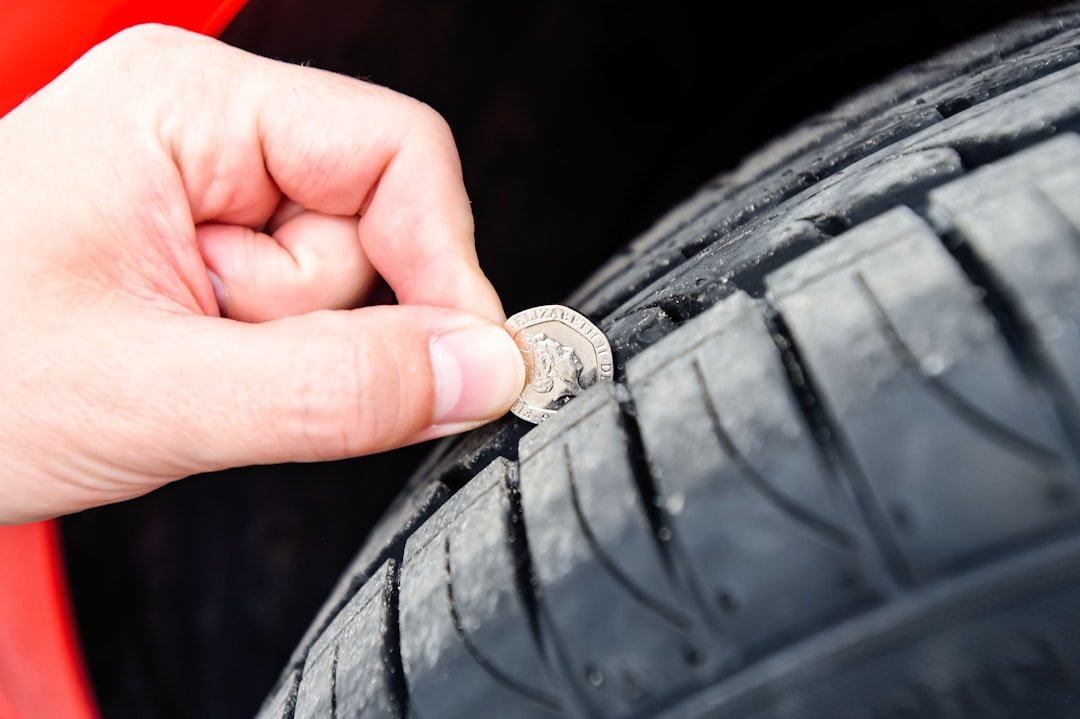
Grab a penny and check the main grooves on each tire now. Knowing how to check tire tread depth takes less than two minutes, and it can catch a worn tire before wet-road grip gets noticeably worse. Park on level ground, turn the front wheels outward if needed, and inspect every tire rather than judging the set by one good-looking spot.
How to check tire tread depth using a penny test
Take a US penny and place it into a main circumferential tread groove with Abraham Lincoln’s head pointing down toward the tire. Use the groove, not one of the thin cuts or sipes in the tread blocks. If the tread reaches over any part of the top of Lincoln’s head, you have more than roughly 2/32 inch of tread remaining at that spot.
If you can see the entire top of Lincoln’s head, the tire is around 2/32 inch or less. That is the common minimum replacement point for passenger tires in much of the US, though local rules and inspection standards vary. Arrange replacement promptly, especially if you drive in heavy rain or carry passengers often.
Do the penny test in at least three places across each tire: the inner edge, the center, and the outer edge. Then repeat it in several locations around the tire’s circumference. Tread rarely wears perfectly evenly. A tire can pass the test in the center and still be worn out along one shoulder.
| Penny-test result | Approximate tread depth | Practical takeaway |
|---|---|---|
| Top of Lincoln’s head is covered | More than 2/32 inch | Continue checking for uneven wear and damage. |
| Top of Lincoln’s head is visible | About 2/32 inch or less | Plan to replace the tire immediately. |
| Tread is close to the wear bars | About 2/32 inch | The tire has reached its built-in replacement indicator. |
Check the wear bars too
The penny is handy, but the tire already has a more direct indicator. Look inside the main grooves for small raised rubber bridges running across the groove. These are tread wear bars. When the surrounding tread is flush with those bars, the tire is at about 2/32 inch.
Wear bars are useful because they are molded into the tire at several points. Rotate the wheel or move the vehicle slightly if you cannot see them clearly. Dirt and road grime can hide them, so wipe the groove with a rag if necessary.
A tire may still show more than 2/32 inch and be a poor choice for wet conditions. Many drivers start shopping around 4/32 inch because water evacuation falls off as grooves become shallow. For winter driving, dedicated winter tires tend to lose a lot of their snow traction well before the legal minimum; around 6/32 inch is a common replacement-shopping point. Your climate, tire type, and driving habits matter here.
Use a tread depth gauge for a clearer reading
A basic tread depth gauge is inexpensive and gives a reading in 32nds of an inch or millimeters. It is the better tool when you are comparing tires, buying a used vehicle, checking an AWD vehicle, or deciding whether one tire can be replaced by itself.
Press the gauge’s base flat against the tread blocks, extend the probe to the bottom of the groove, and read the scale. Measure the same inner, center, and outer locations that you used for the penny test. Write the readings down if you see a difference between tires.
On many all-wheel-drive vehicles, a large tread-depth mismatch can put extra work on the drivetrain. The allowed difference depends on the manufacturer and tire setup, so check the owner’s manual or ask a dealer before replacing only one tire. A tire shop can measure all four and advise whether shaving a replacement tire or replacing a pair is appropriate.
What uneven tread wear tells you
Uneven wear is often more useful than the average depth number. Wear concentrated in the center commonly points to overinflation. Both outer shoulders wearing faster can point to chronic underinflation. One edge worn much harder than the other often suggests an alignment issue, worn suspension parts, or a bent component.
Cupping, which feels like repeated high and low patches around the tread, can be related to wheel balance, suspension wear, or both. A tire that shows cords, deep cracks, bulges, cuts, or a nail near the sidewall needs professional inspection regardless of remaining tread. Do not rely on a penny test to clear visible tire damage.
Check pressures when the tires are cold and use the pressure listed on the driver-door placard, not the maximum pressure molded into the tire sidewall. Keeping the specified pressure and rotating tires on the vehicle maker’s schedule gives you the best chance of even wear. It does not correct an alignment or suspension fault.
FAQ
Is the penny test accurate enough?
It is accurate enough to identify a tire that is near or below the 2/32-inch replacement threshold. It cannot tell you whether the tire has 3/32 or 5/32 remaining, and it does not reveal every wear pattern. Use a gauge when you need a precise number.
Can I use a quarter instead?
A quarter can give a more conservative warning. With George Washington’s head facing down, tread that reaches the top of his head is roughly 4/32 inch. That can be a useful signal to start tire shopping before the penny test fails, particularly in rainy areas.
How often should I check tread depth?
Check monthly when you check tire pressure, before a long road trip, and after hitting a serious pothole or curb. Add a quick look after tire rotation. Regular checks make it easier to spot a problem before one tire becomes much worse than the others.
Does a tire pass if only one groove covers Lincoln’s head?
No. A tire should have adequate tread across its usable width and around its circumference. If an inner or outer groove exposes Lincoln’s head, treat that as a worn-tire warning even if the center grooves look better. Have the uneven wear checked before fitting new tires.
Related posts
This article is for general informational purposes only and is not mechanical, legal, financial, or insurance advice. Prices, insurance rates, tax credits, and manufacturer-stated fuel economy or EV range are estimates that change over time and vary by vehicle, region, and provider — always verify current figures with a dealer, mechanic, insurer, or official source before making a decision.
Disclosure: This post may contain affiliate links. If you click through and make a purchase, we may earn a commission at no extra cost to you. We only recommend products we’ve researched or genuinely believe in.